



Rhythms by the English Channel
Along the Dorset coast, the sound of swing has long arrived with the tide. In Bournemouth, Weymouth, Christchurch, and the surrounding resorts, music was not confined to prestigious city clubs or metropolitan concert halls. It flourished in ballrooms, pier venues, municipal theatres, hotels, ice rinks, and seasonal clubs where holidaymakers and local residents shared the same polished floor. The seaside, often imagined as a landscape of restrained promenades and conventional entertainment, became instead an energetic incubator for jazz, dancing, youth culture, and live performance.
The postwar holiday boom gave this musical life a particularly strong pulse. As paid holidays expanded and families travelled to the coast, resorts required a steady supply of entertainment from afternoon tea dances through to late evening orchestral concerts and informal club sessions. The resulting circuit connected national touring bands with local musicians, traditional dance orchestras with emerging beat groups, and formal ballroom etiquette with the freer movement of Lindy Hop and early modern swing. To understand Dorset’s musical heritage is therefore to follow a journey from elegant dance orchestras to lively jazz revivalism, all carried by venues designed for public pleasure. For visitors planning a cultural break, a Bournemouth Pavilion history offers an especially vivid starting point.
The Architectural Palaces of Seaside Swing
The Pavilion Theatre and Ballroom in Bournemouth embodied the confidence of interwar public leisure. Built after the demolition of the Pier and Belle Vue Hotel, it opened on 19 March 1929 in the presence of the Duke of Gloucester. Designed by G. Wyville Home and Shirley Knight in a restrained Art Deco style, the complex cost approximately £250,000, a considerable investment in the idea that entertainment could be both civic architecture and popular experience.
Its facilities were extensive. A 1,600-seat concert hall, Compton organ, ballroom, restaurants, and tea lounges allowed audiences to move between different forms of sociability without leaving the building. The opening programme combined a Bournemouth Municipal Orchestra recital with variety performances, establishing the Pavilion as more than a theatre. From 1934, an enlarged stage supported plays, operas, ballets, musicals, pantomimes, recitals, and orchestral concerts, while the ballroom hosted afternoon tea dances, evening balls, gala dinners, exhibitions, sporting occasions, and conferences.
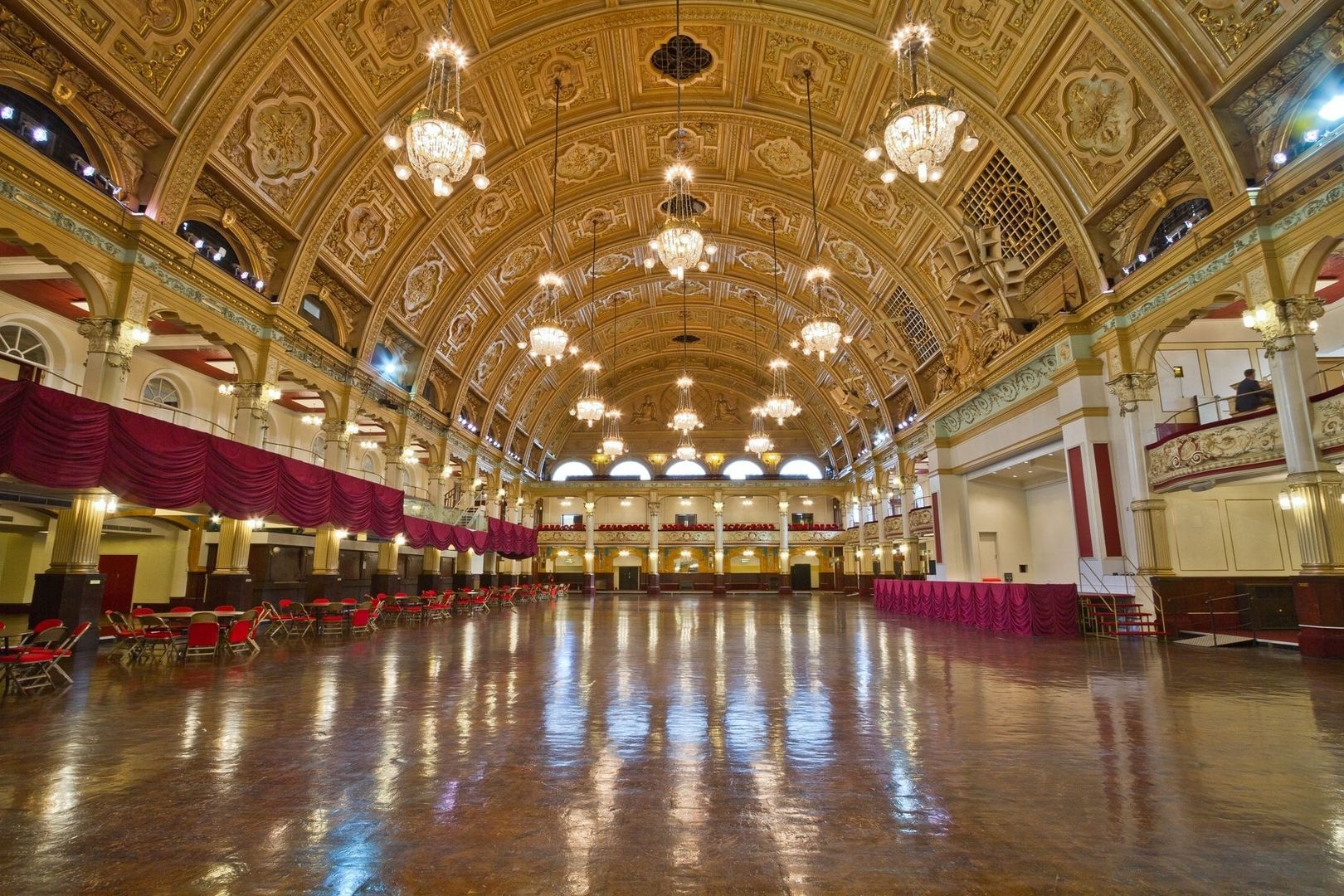
Across the coast, pier dancehalls and municipal ballrooms had to accommodate music that was both powerful and physically communal. High ceilings, broad floors, hard surfaces, balconies, and generous entrances helped create an atmosphere in which brass sections could project across a large crowd and dancers could move without the restrictions of a small club. Programming also reflected the mixed audience. Weekdays might offer tea dances for older holidaymakers, while evenings introduced orchestras, vocalists, novelty acts, or, increasingly, youth-oriented packages.
| Venue type | Typical atmosphere | Programming character |
|---|---|---|
| Municipal theatre and ballroom | Polished, spacious, civic, adaptable | Orchestral concerts, formal dances, variety, touring shows |
| Pier ballroom | Open, theatrical, closely tied to the holiday promenade | Dance bands, seasonal engagements, social dancing, special events |
| Local club | Informal, intimate, often youth-oriented | Jazz groups, beat bands, soul acts, late-night sessions |
| Ice rink and large entertainment hall | High-energy and flexible | Big Beat Nights, package tours, popular touring performers |
By the 1960s, these spaces were adapting to a changing soundscape. The Pavilion Ballroom hosted “Big Beat Nights” and presented artists including Cliff Richard, The Shadows, and Roy Orbison, alongside local performers. Manager Eddie Nunn later promoted Friday Beat Nights and the Moody Sunday Club, seeking to draw Bournemouth residents throughout the year rather than relying solely on summer visitors. The shift was significant: the same architecture that had supported formal dancing now became a platform for amplified popular music, teenage audiences, and a more fluid relationship between listening and dancing.
Touring Maestros and the Local Beat Boom
National touring orchestras brought the glamour and precision of metropolitan swing to Dorset’s holiday crowds. Their arrangements offered a carefully shaped version of modernity, with coordinated brass figures, strong rhythm sections, vocal refrains, and instrumental solos that could be heard clearly across a ballroom. For many visitors, a seaside engagement provided an accessible introduction to styles associated with London, Manchester, and the wider British dance-band circuit.
Yet the significance of the coastal scene lay equally in its local musicians. The circuit between Bournemouth and Weymouth provided regular opportunities for ensembles to build an audience, refine arrangements, and share bills with touring acts. Listings from 1966, compiled from archived issues of the Bournemouth Evening Echo and Bournemouth Times, reveal an unusually busy calendar. The Pavilion Ballroom, Pier Ballroom, Royal Ballrooms, Westover Ice Rink, the Ritz, Le Disque A Go! Go!, and the Starlight Club in Christchurch hosted a mixture of jazz bands, orchestras, soul performers, beat groups, and folk acts.
That variety shows that the local beat boom did not simply replace jazz. It created overlapping layers of performance. A traditional jazz band could appear near a package tour date, while a modern club might present a soul singer one evening and a small jazz ensemble the next. The resort circuit was commercially practical, but it was also culturally porous. Musicians, dancers, holidaymakers, and teenagers encountered sounds beyond the boundaries of a single genre.
- Seasonal intensity: summer brought larger audiences, visiting performers, and extended entertainment programmes.
- Mixed bills: jazz, orchestral pop, beat music, soul, folk, and variety could appear within the same regional circuit.
- Local access: residents could attend nationally recognised acts without travelling to London or other major cities.
- Youth programming: “Big Beat Night” and “Sunday Club” formats helped venues address the growing teenage market.
- Press documentation: local newspapers preserved evidence of a dense and varied gig economy that might otherwise have disappeared.
The 1950s and mid-1960s were therefore marked by coexistence rather than a clean musical break. Refined dance orchestras still mattered, but the arrival of beat groups and American-influenced popular styles changed expectations about volume, performer visibility, and audience behaviour. The seaside ballroom became a testing ground where established conventions met a younger appetite for immediacy, rhythm, and participation.
Revivalism, Lindy Hop, and the Traditional Jazz Counterculture
Traditional jazz revivalism brought a different kind of energy to coastal Dorset. Its advocates looked toward early New Orleans ensembles, collective improvisation, ragtime, blues, and the rhythmic vocabulary that preceded the swing era. The style was often presented as a counterpoint to polished commercial ballroom music. Where a dance orchestra might foreground smooth arrangements and predictable transitions, a revival band invited listeners to hear the personality of individual players within a collective conversation.
The debate was not only musical. The mid-century revival also carried complicated historical language and imagery. The term “Dixieland,” once widely used for a fast, ensemble-based form of revival jazz, has been criticised for its association with romanticised Old South symbols and for implying a narrow geographic origin. As discussed by The Syncopated Times, more accurate descriptions such as “New Orleans jazz” can acknowledge the music’s origins without reproducing a historically damaging label. This matters in any account of British revival culture, because admiration for the music must be separated from the myths that were sometimes attached to it.
For dancers, the connection between music and movement was equally important. Lindy Hop developed in a particular musical environment, shaped by swing tempo, rhythmic accents, breaks, call and response, and the forward momentum of a working dance band. The argument made in writing on swing dancing and music is that Lindy Hop cannot be understood as a neutral choreography suitable for every soundtrack. Its elasticity depends on a musical foundation that gives dancers room to stretch, respond, improvise, and return to the beat.
- Traditional jazz: collective improvisation, blues feeling, ragtime influence, and strong links to early New Orleans practice.
- Big-band swing: arranged sections, powerful ensemble phrasing, vocal features, and a steady social-dance pulse.
- Lindy Hop: elastic partner movement, rhythmic breaks, improvisation, and a close dialogue with the band.
- Modern club culture: less formal audience behaviour, youth-oriented programming, and greater freedom to combine listening with dancing.
Seaside clubs were well suited to this cultural friction. Their audiences were temporary and mixed, and their spaces often allowed conventions to loosen after the formal tea dance had ended. Dancers could move from a disciplined ballroom frame into a more expressive social style, while musicians explored arrangements rooted in New Orleans jazz rather than simply reproducing commercial dance formulas. The result was not a single coastal sound, but a lively argument about what jazz should preserve, what it should change, and how directly it should serve the dance floor.
The Enduring Rhythm of Coastal Festivals
Over time, seasonal dancehall weekends evolved into more structured coastal jazz festivals. The change brought clearer artistic identities, published programmes, multiple venues, workshops, jam sessions, and audiences willing to travel specifically for music. The seaside remained central because it offered a complete festival environment. A listener could attend a morning session, walk along the promenade, return for an afternoon band, and finish with a late-night set, all within a compact resort landscape.
The continuing strength of this model depends on local organisation. Volunteer committees, venue managers, musicians, dancers, archivists, and audiences all help maintain the circuit. The Bude Jazz Festival review demonstrates how a small coastal town can sustain an ambitious programme through volunteer commitment, presenting dozens of bands across traditional New Orleans jazz, blues, ragtime, mainstream, bop, and the American Songbook. Its morning jams, walkable venues, younger performers, and welcoming atmosphere illustrate how festival culture can preserve tradition without turning it into a museum piece.
Contemporary UK programming also treats jazz as a broad, evolving field. Major festivals increasingly combine established players with emerging artists, DJs, dance stages, soul, hip hop, and genre-crossing projects. That approach echoes the old Dorset ballroom circuit, where audiences encountered several musical generations under one roof. Historic pier ballrooms and theatres remain valuable not simply because they are picturesque, but because their architecture still encourages collective listening and social movement.
For cultural tourists, the best way to experience this legacy is to combine historical attention with practical curiosity. Check current listings, allow time to explore the surrounding promenade, and look for workshops or early evening sessions as well as headline concerts. A small local ensemble may reveal more about the living tradition than a grand retrospective, particularly when the room fills with dancers and the distinction between audience and participant begins to soften.
Step Into the Living Echoes of Dorset Swing
Dorset’s mid-century seaside dancehalls left a cultural footprint far larger than their holiday reputation might suggest. They connected national touring orchestras with local musicians, gave young audiences access to new sounds, and allowed traditional jazz revivalism to develop within a setting built for sociability. Bournemouth’s Pavilion, the pier ballrooms, club rooms, and larger entertainment halls each contributed to a musical ecology in which swing was heard, danced, debated, and continually reinvented.
Many of the original venues have changed purpose, and some have disappeared, but the rhythm survives in local festivals, dance nights, archival projects, and contemporary jazz programmes. Explore the surviving architecture, consult historical gig records, and seek out performances where musicians and dancers share the same pulse. Along the Dorset coast, the past is not silent. It returns whenever a band strikes up, a floor opens, and the old seaside invitation to listen and move begins again.