



The Secret Language Beneath the Melody
In a dimly lit jazz room, attention naturally travels towards the horn, the singer, or the pianist poised beneath the spotlight. Yet the performance often takes its first breath lower down, where the double bassist and drummer establish a shared climate of time, weight, and expectation. The room seems to inhale with the band. A bass note settles into the floorboards, a ride cymbal opens a fine thread of light above it, and suddenly the ensemble feels less like a collection of players than a single breathing organism.
That impression challenges the familiar idea of the rhythm section as a pair of human metronomes. The drummer is not merely marking beats, and the bassist is not simply counting measures with low notes. Their work is conversational, responsive, and full of minute decisions. A fractionally delayed bass attack, a snare placed just behind the expected point, or a cymbal accent withheld until the soloist needs air can alter the entire emotional contour of a performance. This is the hidden dialogue that gives jazz its vitality, transforming written form into a living event.
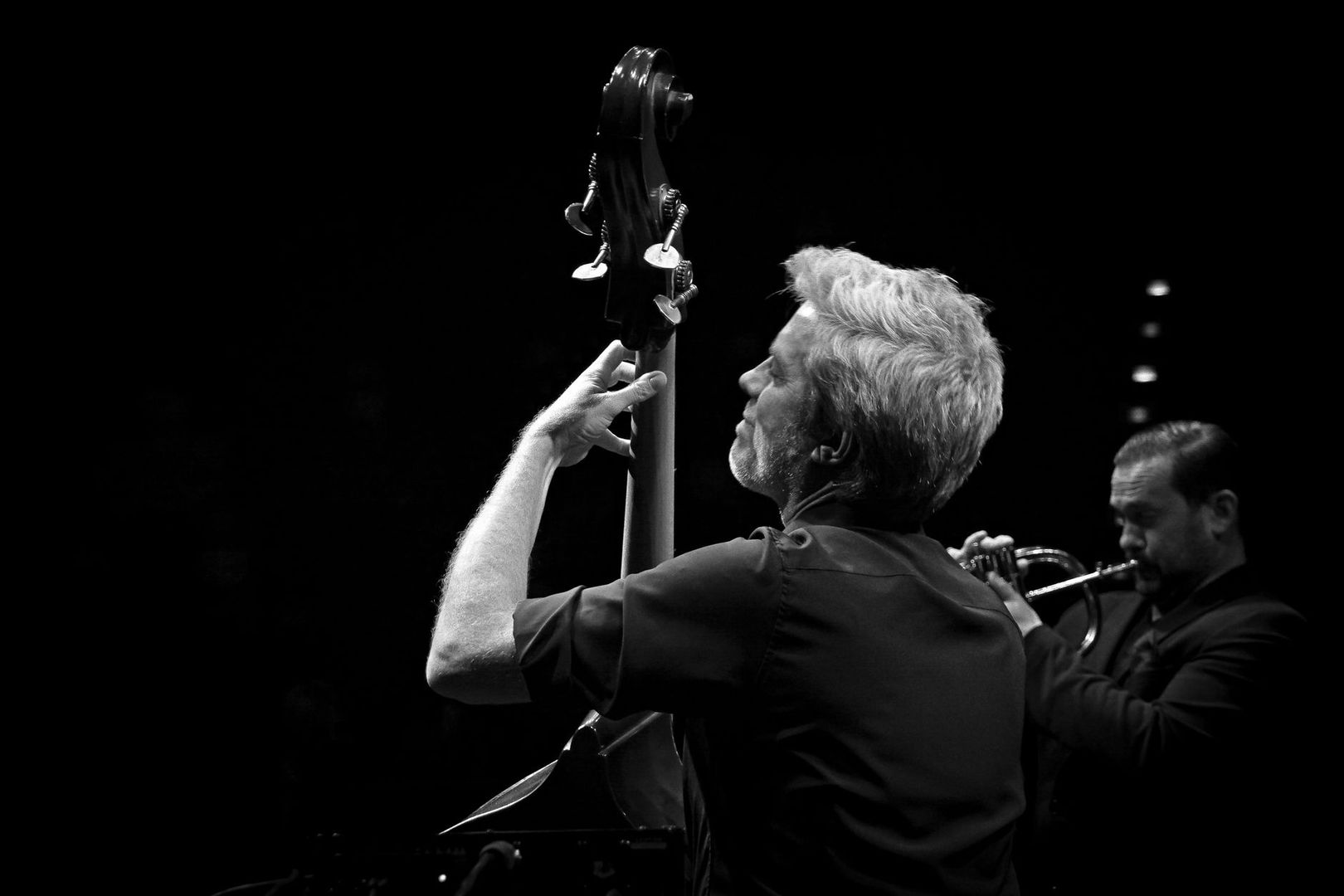
The Anatomy of the Pulse and Shared Architecture
The double bass supplies more than a low register. Through walking lines, it sketches the harmonic route while giving the music a physical sense of forward motion. Each note may identify a chord, prepare the next change, or create a small rhythmic hook that the rest of the band can inhabit. Above it, the ride cymbal cuts through the temporal air with a pattern that is both continuous and flexible. Its shimmer does not simply announce where the beat is; it suggests how the beat might breathe.
When these sounds meet, acoustic low end and metallic resonance form a composite texture. The rounded body of the bass gives the groove warmth and gravity, while the cymbal supplies definition, lift, and a sense of horizontal movement. The blend depends on more than volume. It is shaped by bow or finger attack, the resonance of the instrument, the drummer”s touch, the room”s acoustics, and the musicians” judgment about when to leave space. In a small club, a light ride pattern may be enough. In a festival tent, the same idea may require a firmer bass articulation and carefully controlled cymbal sustain.
This division of labour only works when it is accompanied by mutual trust. The bassist must believe that the drummer will frame time without imprisoning it. The drummer must trust the bassist to sustain harmonic direction even when the surface becomes deliberately ambiguous. The broader rhythm section tradition describes this foundation as a collaborative unit that supports pulse, harmony, and groove, but live performance reveals how fluid those responsibilities can become.
- The bassist outlines harmony, reinforces the form, and determines much of the music”s physical weight.
- The drummer shapes time through subdivision, accents, colour, dynamics, and silence.
- Both players monitor the soloist while constantly adjusting their own relationship.
- The ensemble”s stability comes from listening, not from mechanical repetition.
Micro-Timing and the Elasticity of Groove
Jazz timing is often discussed as though every note must occupy a fixed grid, but the most compelling performances reveal several possible relationships to the beat. Playing ahead of the beat can create urgency, anticipation, or a feeling of forward lean. Playing dead centre produces clarity and firmness, particularly useful when a complex arrangement needs an unmistakable foundation. Laying back, by contrast, introduces relaxation and depth. None of these positions is automatically superior. Their expressive value comes from the relationship between players and from the stability of the underlying tempo.
The crucial point is that push and pull do not necessarily mean speeding up and slowing down. A bassist may place the beginning of a note slightly forward while allowing its resonance to settle behind the beat. A drummer may keep the ride cymbal steady but place a snare accent fractionally later, producing swing without disturbing the bar line. The result is elasticity within continuity. This interaction is central to Ingrid Monson”s Saying Something, a major study of jazz improvisation that treats rhythm-section interaction as an inventive musical process rather than background support.
Listeners can hear these choices as bodily sensations before identifying them intellectually. A forward bass line may make a phrase feel eager; a relaxed cymbal and slightly late snare may make the same tempo feel spacious. When the players disagree unintentionally, the groove can sound heavy, nervous, or unsettled. When the difference is deliberate and coordinated, the music acquires character. The band appears to stretch time while remaining securely inside it.
| Micro-timing pairing | Likely listener perception | Typical expressive effect |
|---|---|---|
| Bass ahead, ride centred | Forward-moving and alert | Urgency, propulsion, anticipation |
| Bass centred, snare slightly behind | Relaxed but grounded | Depth, swing, conversational ease |
| Bass and ride both centred | Clear and stable | Precision, transparency, structural confidence |
| Bass slightly behind, cymbal lightly ahead | Suspended and spacious | Elasticity, tension, room for a soloist |
Cymbal Colors and the Wood of the Double Bass
The marriage between double bass and cymbal is also a meeting of materials. Gut or steel strings produce a complex attack followed by a wooden, resonant bloom, while hand-hammered Turkish cymbals contribute a spectrum of metallic frequencies that can sound smoky, papery, glass-like, or explosive depending on the stroke. The bassist”s fundamental tones occupy the lower register, but the instrument also generates upper harmonics. The cymbal does not merely sit above this sound; it threads through it, illuminating the edges of each phrase.
Brushwork changes the room”s tactile atmosphere. Instead of a series of sharply defined attacks, brushes create a continuous whisper, with circular motion replacing the harder punctuation of sticks. That softer surface can free acoustic space for subtle bass details, including muted notes, gentle slides, and the changing texture of finger contact. In high-energy improvisation, dynamic control becomes essential. A drummer who understands the difference between a full crash, a controlled swell, and a quiet ride touch can preserve clarity even when the ensemble reaches its loudest point. The same principle applies to the bassist, whose amplification, articulation, and note length determine whether the low end supports the music or obscures it.
- Brushes soften the transient attack and make room for bass resonance.
- Ride cymbals can provide continuity without overwhelming harmonic detail.
- Crash cymbals are most effective when their arrival has structural purpose.
- Controlled bass sustain prevents the low register from becoming indistinct in dense passages.
How the Engine Room Elevates the Soloist
A soloist rarely performs over an unchanging backdrop. The drummer and bassist anticipate phrasing, breath, harmonic tension, and physical gesture. If a saxophonist leaves a long pause, the bass may hold a pedal point while the drummer reduces the surface to a few suggestive sounds. If a pianist begins stacking dissonance, the rhythm section can either intensify the pressure or create a stable frame against which that tension becomes legible. In both cases, the accompaniment is interpretive. It hears the soloist”s direction and responds before the idea has fully arrived.
Pedal points are especially powerful because they suspend harmonic movement while preserving momentum. A repeated bass note can create a floor beneath increasingly adventurous lines, while the drummer changes density and accent placement around it. Metric modulation can make a new pulse seem to emerge from the old one, often through a subdivision that changes its perceived role. Dropped accents, meanwhile, create negative space. When the expected hit disappears, the audience notices the silence, and the eventual return carries greater force. These devices build climaxes without relying solely on volume.
For festival and club audiences, the engine room becomes easier to follow with a few deliberate listening habits. Instead of waiting only for the next solo, watch how the foundation changes the conditions around it. A quiet passage may contain more strategic information than a loud one, particularly when the musicians are negotiating where the next phrase will land.
- Listen first to the bass”s walking direction. Notice whether each note seems to confirm the harmony, lead towards it, or deliberately postpone it.
- Then follow the drummer”s ride pattern and ask whether it remains constant, opens out, fragments, or shifts towards the snare and toms.
- Watch for coordinated changes in volume. When both players become quieter, the ensemble may be preparing a soloist”s entrance rather than losing energy.
- Notice moments when an expected accent is withheld. The silence may be a cue, a structural turn, or an invitation for the soloist to answer.
- At a climax, distinguish intensity from speed. The band may feel faster because the subdivisions and accents have become denser, even while the tempo remains steady.
Tune Your Ears to the Bandstand Handshake
The drummer and double bassist create a form of telepathy that is audible only through its consequences. Their conversation establishes whether a melody will feel buoyant or grounded, whether a solo will unfold in open air or against mounting pressure, and whether a final cadence arrives as a conclusion or as a springboard. Individual virtuosity matters, but it becomes meaningful when it is absorbed into collective momentum. The most memorable bandstand moments often arise not from the loudest gesture, but from two musicians adjusting to one another by a nearly invisible degree.
At the next live session, whether in an intimate club or a busy festival room, let attention travel beyond the front line. Follow the bass note that changes the emotional temperature of a chord. Hear the ride cymbal”s particular shade. Notice how brushes reshape the room, how a snare accent lands just late enough to make the phrase smile, or how a sudden silence gives the soloist somewhere to go. Listening in this way is not passive reception. It is an active art, a form of participation in the bandstand handshake that turns separate sounds into a shared event.