



Stepping Beyond the Lyric to Find the Voice as a Frontline Horn
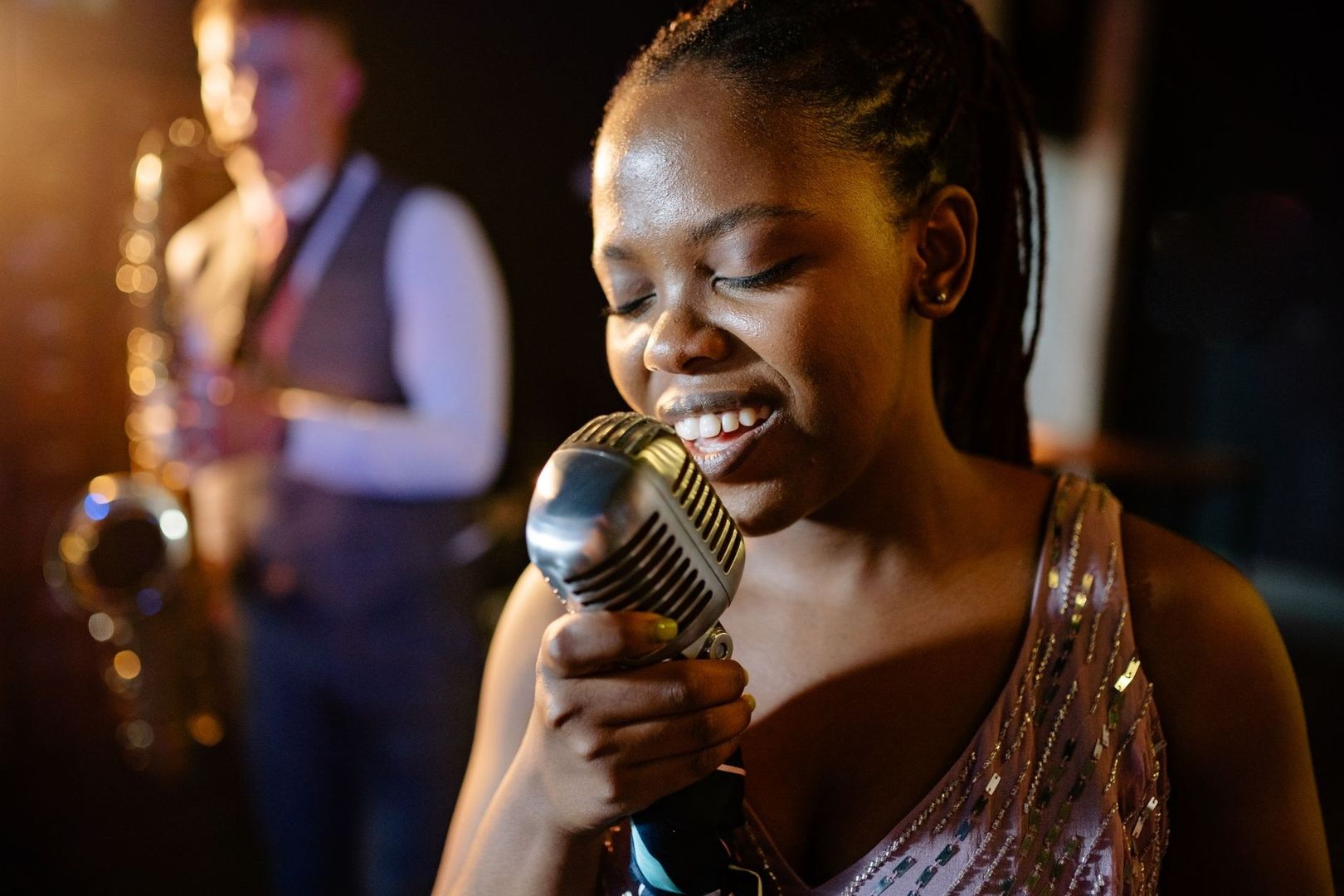
In a dimly lit contemporary jazz room, the vocalist may begin with a recognisable lyric, then quietly dismantle its expectations. A consonant lands ahead of the beat. A vowel bends through several shades of pitch. Breath becomes a soft cymbal, a clipped syllable answers the drummer, and a phrase seems to hover between speech and song. The effect is not a retreat from musicianship or melody. It is a decision to treat the voice as an agile acoustic instrument, capable of colour, attack, resonance and rhythmic risk beyond the polished ideals of conventional bel canto delivery.
The journey from mid-century syllable scatting to present-day speech-derived prosody has not erased the jazz tradition. It has widened its vocabulary. Contemporary singers draw on scat, vocalese, spoken word, extended technique, electronics and instrumental imitation, often within the same chorus. Their phrasing can carry semantic meaning while behaving like a horn line, or abandon language altogether in favour of clicks, cries, overtones and grain. The 21st-century vocalist therefore appears less as a traditional lyric narrator and more as a harmonic horn player, negotiating the bandstand through timbre, microtonal inflection and highly responsive rhythmic placement.
Breaking Free from the Syllable Trap of Standard Bebop
Classic bebop scat established a powerful model for vocal improvisation. Singers used invented syllables to imitate the speed, articulation and melodic freedom of instrumental soloists, converting the voice into a trumpet, saxophone or rhythm section. The approach remains thrilling when the syllables have purpose, but formula can quickly take over. Repeated patterns such as “doo-bah,” “bap” and “shoo” may suggest movement without necessarily revealing how the singer hears the harmony or inhabits the groove.
Contemporary innovators often begin elsewhere, with the cadence of ordinary speech. A phrase may sound interrupted, conspiratorial, emphatic or deliberately unfinished. Micro-accents can fall between familiar subdivisions, while a consonant may function like a snare hit and a stretched vowel like a sustained string or brass tone. Spoken word and improvisation meet in this territory, allowing singers to preserve the expressive pressure of language even when no literal sentence is being delivered.
For listeners, the most revealing details are often smaller than the headline gesture. Track where a singer places the final consonant of a word, whether a breath arrives before or after the expected pulse, and how a phrase responds to a drummer”s displaced accent. Notice whether an invented syllable has a hard attack, a rounded resonance or a deliberately unstable pitch. A practical resource such as Vocal Improvisation: An Instru-Vocal Approach for Soloists, Groups, and Choirs treats improvisation as a combination of ear training, rhythm, instrumental concepts and vocal practice, a useful framework for understanding why contemporary freedom is built on disciplined listening rather than randomness.
- Listen for speech rhythms that interrupt evenly spaced scat patterns.
- Follow consonants as rhythmic events, especially when they align with drums or percussion.
- Hear how a singer shades a single pitch with slides, vibrato, breath and vocal grain.
- Notice when a phrase answers the band rather than simply floating above it.
A Sonic Blueprint Comparing Traditional Delivery to Contemporary Vocalise
A traditional Great American Songbook interpretation often places lyric clarity, melodic contour and emotional narrative at the centre. The singer shapes a song so that its words remain legible and its harmonic movement feels elegantly inevitable. Contemporary vocalise may preserve those qualities, but it can also treat the song as a field for investigation. A melody might be fragmented, reharmonised, spoken, displaced or reduced to a few intervallic cells. The voice no longer occupies only the front of the arrangement. It can move inside the texture, challenge the piano”s voicings or become another member of the rhythm section.
| Vocal parameter | Traditional delivery | Contemporary vocalise |
|---|---|---|
| Pitch flexibility | Stable intonation with expressive vibrato and controlled ornament | Microtonal slides, pitch smears, speech inflection and intentional instability |
| Consonant use | Primarily serves textual clarity | Functions as attack, punctuation and percussion |
| Rhythmic placement | Swings or lays behind the beat within a recognisable phrase | Moves across the grid through rubato, displacement and speech-derived accents |
| Ensemble hierarchy | Voice leads while the band supports | Voice exchanges roles with drums, bass, piano and electronics |
This comparison is not a ranking system. A beautifully centred ballad can demand more control than an apparently unruly improvisation, while a daring vocal texture can reveal an equally rigorous command of breath and resonance. The important shift concerns function. When the larynx is approached like brass or a reed instrument, the singer becomes alert to attack, register, resistance and decay. The bandstand balance changes because the voice can converse with the horn section, shadow the bass line, punctuate a drum figure or dissolve into the room”s acoustic atmosphere.
The Anatomy of Extended Vocal Techniques on the Bandstand
Extended vocal techniques begin with physical choices. A microtonal slide may involve controlled movement through the pitch rather than a clean arrival at a target note. A growl introduces roughness and low-frequency friction, while an air flutter emphasises the sound of breath passing through the instrument of the body. Multiphonics, in which more than one perceived pitch or resonance is produced, can make the voice seem briefly electronic or reed-like. These sounds are not merely effects added after the musical idea. They alter the available vocabulary of attack, duration, density and emotional temperature.
Research on extended vocal practice distinguishes these methods from the priorities traditionally associated with Western classical pedagogy, especially precise pitch, textual clarity and tonal purity. The doctoral study available through the Research Portal examines techniques including growls, cries, whispers, laughter, overtone singing, vocal fry, Sprechstimme, multiphonics and percussive vocalisation. Its discussion of Bobby McFerrin and Linda Sharrock is especially useful for hearing two different artistic paths: one integrating unconventional sounds into established musical frameworks, the other disrupting conventional ideals of vocal beauty.
In a close club setting, the microphone makes these distinctions unusually vivid. A whisper can sit above a quiet bass note without needing to become a full singing tone. A tongue click can operate like a miniature hi-hat, while a dry vocal fry creates a dark surface beneath a melodic fragment. Because the microphone captures transient detail, the singer can work at a smaller physical scale than in a large concert hall. Subtle throat noise, the opening of a breath and the sudden closure of a consonant all become audible parts of the arrangement.
- Microtonal slides: Listen for the journey between notes, not only the destination.
- Guttural growls: Hear how roughness changes the emotional weight and instrumental analogy of a phrase.
- Air flutters and whispers: Notice the boundary between voiced tone and audible breath.
- Multiphonics and overtones: Follow the extra resonance that makes one voice suggest several pitches or layers.
- Clicks and percussive attacks: Identify moments when the mouth joins the drummer”s rhythmic vocabulary.
Listening with a Musician’s Ear at Your Next Jazz Gig
A live performance becomes more absorbing when the vocalist is heard as part of a moving ensemble rather than as a separate attraction. The next time a singer takes an improvised chorus, resist the temptation to judge the passage only by lyrical beauty or vocal power. Listen for decisions. Is the voice reinforcing the bass, resisting it or leaving deliberate space around it? Does the piano comping invite a response? Does the drummer answer a syllable, or does the singer anticipate the drummer”s next accent?
- Track the relationship between vocal attacks and the drummer”s ride pattern, snare accents or cymbal openings.
- Listen to the upright bass for the harmonic floor, then notice whether the singer outlines, extends or contradicts it.
- Observe how piano comping creates spaces that the vocalist fills with sound, silence or a short spoken gesture.
- Follow rubato passages and ask whether the underlying harmonic pocket remains perceptible.
- Hear each breath as punctuation, marking a comma, a full stop, a dramatic hesitation or a change of direction.
Rubato is particularly revealing. The strongest flexible phrasing does not simply abandon time. It stretches the surface while retaining a bodily sense of where the pulse lives. A singer may delay a word until the chord is almost ready to change, then snap into the next bar with startling accuracy. Another may elongate a vowel across several beats while the bass continues to make the harmonic structure audible beneath it. The tension comes from knowing that the pocket has not disappeared, even when the voice seems to float beyond the metric grid.
Breath control should be heard in the same musical way. A breath can create anticipation, separate two characters in a spoken passage or make a sudden entrance feel inevitable. In intimate venues, silence between phrases may carry as much information as the notes themselves. This kind of attention also makes unfamiliar performances easier to enter. Instead of asking whether a vocal sound resembles a conventional solo, the listener can ask what role it plays in the conversation unfolding across the stage.
Tune Your Ears to the Next Horizon of Modern Sound
Modern jazz vocalists have not abandoned the history of the form. They have taken its central proposition, that improvisation can transform the present moment, and applied it to every aspect of the voice. Syllables, lyrics, breath, noise, pitch and silence can all become material. The singer may be a storyteller in one bar, a horn player in the next and a percussionist a moment later, while still remaining recognisably human in the grain of the sound.
At the next local jazz performance, enter the room ready for more than a polished song interpretation. Welcome dissonance, speech cadence, imperfect edges and textural risk as signs of an active musical dialogue. Live vocal improvisation is not a historical reenactment of bebop technique. It is an immediate exchange between body, band, room and audience, continually reshaped by the acoustics and the night. Listening closely reveals the real invitation: to hear the human voice not as a fixed category, but as an instrument still discovering what it can become.